




Ant Colonies vs Human Cities: What We Can Learn from Ants


Look at a satellite image of a city at night. The lit grid, the sprawl that hits the geographic limit and folds back on itself, the patches of warehouse zones, the dark rectangles of parks. It looks designed because someone designed it, and someone designed it because no city of any meaningful size has ever organised itself.
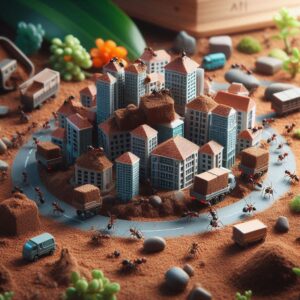
Then look at a leafcutter ant nest. There are no satellite images of those, but if there were, what you’d see is roughly the same pattern. Concentric chambers radiating out from a deep brood centre. Specialised districts: fungus gardens here, waste pits there, royal chambers deep underground. Transport corridors connecting everything. A perimeter of guards. Daily streams of foragers moving along trails as predictable as any city’s commuter routes.
Nobody designed it. No leafcutter ever drew a blueprint. The 50-million-year-old city plan is encoded in pheromones, behavioural rules, and stigmergic feedback loops — instructions so simple that no individual ant understands the result, and yet the result is more efficient than most things we build.
The forager rush hour
In the morning, a leafcutter colony pushes a column of workers into the surrounding forest. The trail looks chaotic — ants walking in both directions, varying speeds, some carrying leaves, some empty-handed. It is the opposite of chaotic. Each ant is following a chemical signal of just two or three pheromones, modulated by recent traffic.
The most studied trait of ant trails is that they reach near-optimal solutions to traveling salesman problems faster than most computer algorithms. The colony does not know it is solving the traveling salesman problem; it is just laying pheromones in proportion to how much food a path delivered, and avoiding paths where signals decayed without renewal. The optimisation emerges.
Human cities have spent decades trying to do the same thing with traffic. We added timed lights, smart signals, congestion pricing, dynamic routing apps. The ants got there with chemistry and a few decades of evolutionary feedback. The comparison is not flattering.
Division of labour
The most cited difference between ant colonies and human cities is the division of labour. Workers in an ant colony specialise — brood care, foraging, defence, construction — and rotate through specialisations based on age. Cities, we say, are mosaic patchworks of specialisation; the office district, the industrial belt, the residential zones.
The similarity is real but shallow. In a leafcutter colony, every worker is genetically a sister of every other worker. They share a queen. Their interests are aligned — what helps the colony helps every worker’s reproductive success through inclusive fitness. Cooperation is enforced by biology.
In a human city, the residents are unrelated, with conflicting interests. Cooperation is enforced by laws, social norms, money, and the threat of consequences. A city is held together by negotiation. A colony is held together by chemistry. The two are doing similar work with profoundly different mechanisms — and the chemical version is older, simpler, and in many specific cases more efficient.
Waste management
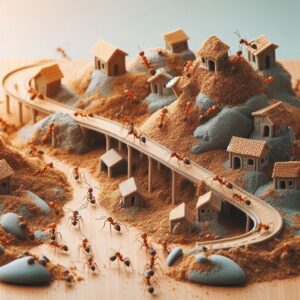
Every ant colony of meaningful size has a waste management strategy. Leafcutters designate specific chambers as refuse dumps. Older workers, near the end of their lifespan, are the ones who handle waste — exposing the most expendable members to the highest pathogen risk. Some species use antibiotic-producing bacteria in their waste chambers to suppress pathogens.
Cities did not develop systematic waste management until the 19th century in most cases. London in 1850 was dumping raw sewage into the Thames and wondering why cholera kept happening. Ants got this right around the time mammals were figuring out how to nurse.
Defence and immune response
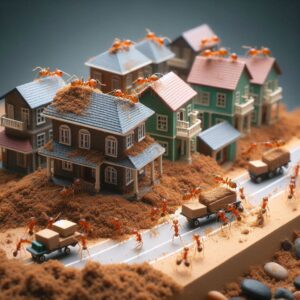
A colony under attack mobilises in seconds. Alarm pheromones release from disturbed workers, propagate through the nest, and bring defenders to the threat. The response is coordinated without command. The colony has an immune system in the same sense a human body does — not through deliberate planning, but through distributed sensors and feedback loops.
Human cities have police, fire services, public health departments. They are command structures. They respond fast for sudden events but rely on top-down coordination. When the coordination breaks — disasters that overwhelm centralised systems — the city does not have an automatic decentralised response.
This is one place where the ant model is genuinely superior. Resilience through decentralisation, not through bigger central authorities.

Where ants fail
None of this means colonies are better than cities. They are differently optimised.
Ant colonies cannot innovate. The behavioural rules are inherited; novel situations get handled with combinations of existing responses, never with new behaviours. A city facing climate change, pandemic, or technological disruption can deliberate, decide, and shift. A colony cannot. If the rules do not cover the situation, the colony fails — sometimes catastrophically.
Ant colonies cannot grow indefinitely. Most species hit a size ceiling determined by the geometry of the nest and the chemical communication range of pheromones. Cities also have growth ceilings, but those ceilings are higher and more flexible. Humans built the megacities of the 20th century because we could solve communication and logistics problems that no ant species could.
Ant colonies cannot reflect on themselves. They optimise toward whatever fitness function their evolution settled on. They cannot ask whether the fitness function is right. Cities can — and many of them spend most of their political energy doing exactly that.
What we can take from them
A few specific points where the ant model has been deliberately copied:
- Ant Colony Optimisation algorithms are now standard in routing and logistics. UPS uses ACO-derived methods to optimise package delivery routes. The savings are measured in hundreds of millions of dollars per year.
- Stigmergic coordination — the idea that individuals can coordinate without direct communication by modifying their shared environment — appears in robotics swarms, distributed computing, and open-source software development.
- Decentralised resilience in network design — internet routing, electrical grids, supply chains — increasingly draws on biological models from ants and other social insects.
The lesson is not that we should imitate ants. It is that we should pay attention to what 140 million years of optimisation produced and ask whether our centralised, top-down problem-solving is the only way.
The colony on your desk
If you keep an ant colony, you have one of these distributed optimisation engines in your home. Watching it is not just observing animals. It is observing a problem-solving system that predates human civilisation by hundreds of millions of years and is still doing things our cities only partially understand.
Browse live colonies — every species teaches a slightly different version of the lesson. The nine ant superpowers covers the biology behind the city analogy in more depth, and the diversity of ants gives the evolutionary timeline.