




50 Amazing Facts About Ants You Probably Didn’t Know

Lists of “amazing facts about ants” usually repeat the same ten data points. This is the longer version, fifty facts organised in five categories, with the genuinely strange ones at the end. Use the table of contents to jump around.
Sections: Evolution & biology · Intelligence & senses · Behaviour & society · Records & superlatives · The genuinely weird
Evolution & biology, 10 facts
- Ants are 140 million years old. Older than flowering plants, older than primates, older than dinosaurs went extinct.
- Ants evolved from wasps. The earliest ant fossils show clear wasp-like features. The defining moment was losing the wings in worker castes.
- There are around 14,000 described ant species, with another 10,000+ estimated to exist undescribed. The species count climbs every year as taxonomic work continues.
- Ants are found on every continent except Antarctica. They occupy a wider geographic range than mammals.
- The total biomass of ants on Earth is roughly equal to the biomass of all humans. Some estimates put it slightly higher.
- Ant queens can live 15-30 years. Lasius niger queens have been documented at 28 years in captivity, the longest recorded for any solitary insect.
- Worker ants live weeks to a few years, depending on caste and species. Major workers tend to outlive minors.
- An ant has six legs, each with three pairs of muscles. The leg structure is optimised for both speed (chase) and load-bearing (carrying).
- Ants have two stomachs. One for personal digestion, one (the “social stomach” or crop) for storing food to share with nest-mates.
- Ant brains contain about 250,000 neurons, small by mammalian standards but unusually dense for the body size. A colony of 50,000 workers has more total neurons than a human.
Intelligence & senses, 10 facts
- Ants do not “hear” sound in the human sense. They sense vibration through leg sensors and air pressure changes through specialised hairs.
- They taste with their feet. Chemoreceptors on the legs let foragers identify food before mandible contact.
- Some species recognise their nest-mates by chemical signature, a colony “smell” carried in hydrocarbons on the cuticle. Foreign ants smell wrong and trigger an attack response.
- Cataglyphis ants navigate by polarised sunlight. They calculate their position using internal step counters and the polarisation pattern of the sky.
- Ants can recognise themselves in mirrors. Or at least, some species demonstrate self-directed behaviour when faced with a mirror image and a paint mark, a primitive version of the mark test used on apes.
- Worker ants modify their behaviour based on collective state. If the colony is short on food, workers spend more time foraging; if water is needed, more workers fetch water, without explicit instruction.
- Some species teach. Experienced foragers slow down to allow naive workers to follow, demonstrating a primitive form of pedagogy.
- Ants use about 20 distinct pheromones for different signals, alarm, recruitment, food, nest identification, queen presence.
- Many ant species cannot see colour. Most ants are sensitive only to ultraviolet and green wavelengths.
- Some ants can count their steps. Lab experiments shorten or lengthen Cataglyphis legs and observe that the ants overshoot or undershoot proportionally, proof of step counting.
Behaviour & society, 10 facts
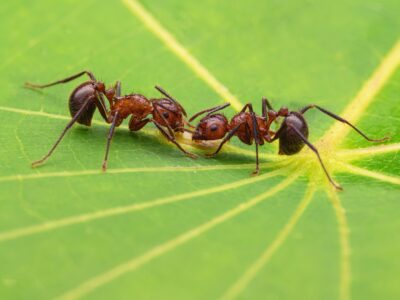
- Most ant colonies are matriarchal. Queens rule, males appear briefly for mating, workers are female.
- Workers reach the role of forager only late in life. Foraging is dangerous; the colony assigns it to the most expendable individuals.
- Ants bury their dead. Many species drag deceased workers to designated waste areas outside the nest, a practice called necrophoresis.
- Some species farm fungus. Leafcutter ants cultivate a specific fungus on chewed plant material, harvesting nutritive structures the fungus produces.
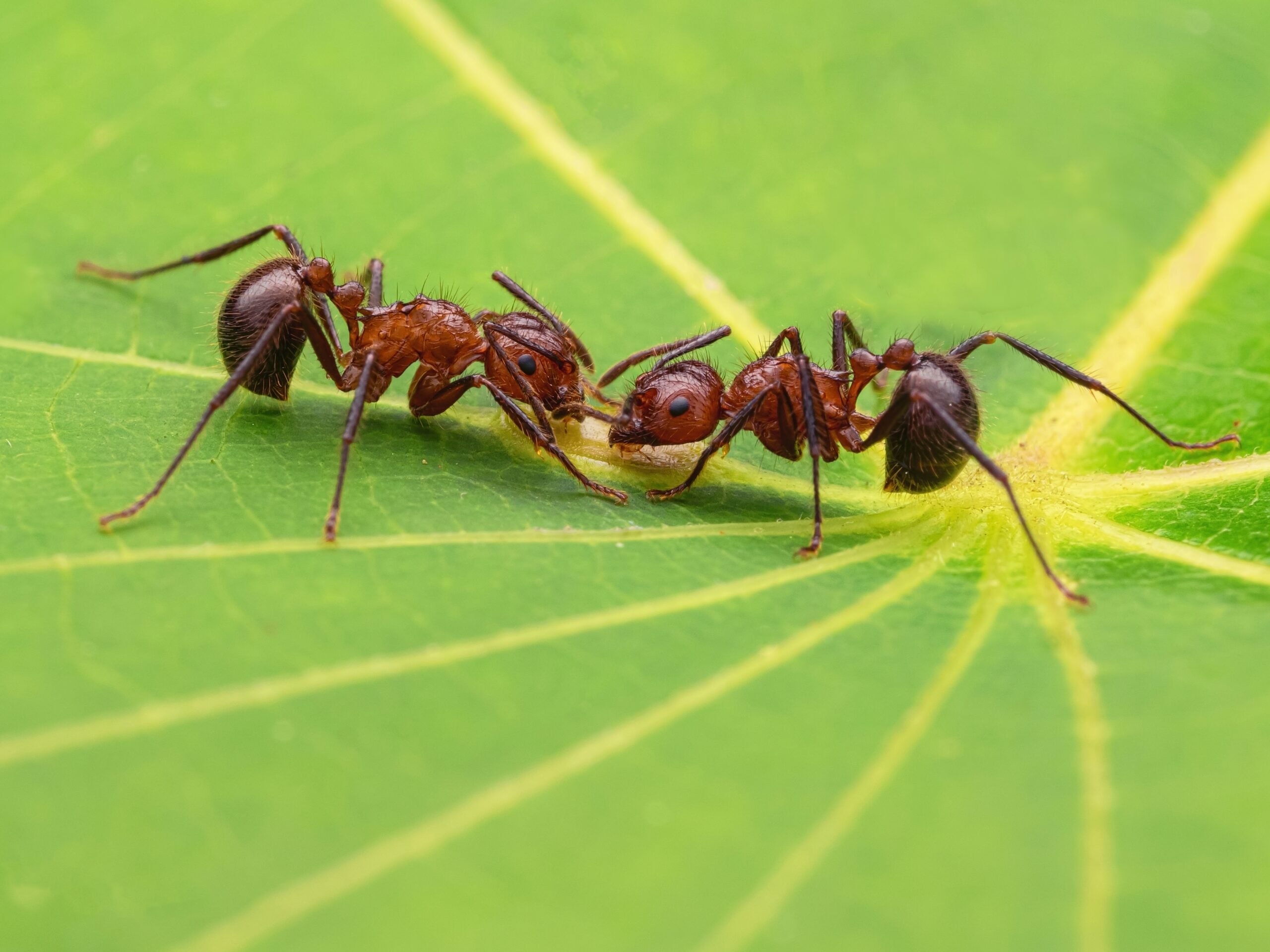
- Other species farm aphids. Workers protect aphid colonies on plants and harvest the sugary honeydew the aphids produce.
- Ants can swim. Many species cross water by linking bodies into a raft that floats; fire ants do this routinely during floods.
- Some species enslave others. Slave-maker ants raid foreign nests, steal pupae, and raise the captured brood as their workforce.
- Worker reallocation is dynamic. If a colony loses many young workers, middle-aged workers shift to brood care; if it loses foragers, young workers age up early.
- Ants engage in territorial wars. Neighbouring colonies of the same species often fight for territory and food resources, sometimes with thousands of casualties.
- Pheidole majors only emerge once the colony reaches a certain size. The colony “decides” when to start raising the major caste, based on workforce demands.
Records & superlatives, 10 facts
- Largest ant species: Dinomyrmex gigas, with major workers approaching 3 cm in length. Queens are slightly larger.
- Smallest ant species: several thief ants in the genus Solenopsis are under 1 mm long.
- Fastest ant: Cataglyphis bombycina, the Saharan silver ant, sprints at over 80 cm per second, about 100 body lengths per second.
- Most painful sting: the bullet ant (Paraponera clavata) ranks at the top of the Schmidt pain index. Pain lasts 24 hours.
- Largest colony ever recorded: the Argentine ant supercolony that spans roughly 6,000 km along the Mediterranean coast. Estimated to contain billions of workers.
- Heaviest load lifted (relative): Asian weaver ants demonstrate sustained carrying of around 100× their body weight.
- Highest temperature tolerated: Saharan Cataglyphis bombycina forages on sand surface temperatures of 50-60°C.
- Most northern ants: some Formica species range above the Arctic Circle in northern Scandinavia.
- Longest documented colony lifespan: a Lasius niger colony in private cultivation passed 28 years.
- Most species in a single genus: the genus Pheidole, with over 1,000 described species worldwide.
The genuinely weird, 10 facts
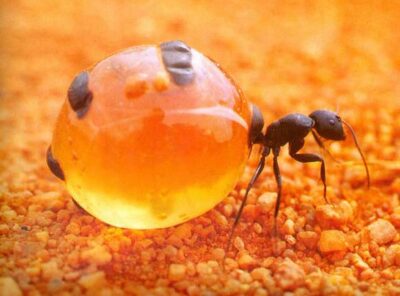
- Honeypot ants have specialised workers (repletes) whose abdomens swell with stored honey, hanging from the ceiling of the nest as living storage vessels. Other workers feed from them on demand.
- Ants infected by Cordyceps fungus climb to a precisely correct height before dying, allowing the fungus to release spores onto the colony below. The fungus controls the ant’s brain.
- Some Harpegnathos worker ants can become queens. If the colony’s queen dies, workers fight for dominance through ritualised duels; the winner develops functional ovaries and takes over.
- Trap-jaw ants can fire their mandibles at over 230 km/h, the fastest predatory strike in the animal kingdom.
- Female workers of Mycocepurus smithii reproduce asexually. No males have ever been found. The colony is genetically a single individual cloned across thousands of bodies.
- Some species “vaccinate” their colonies. Workers infected with pathogens groom each other; the small dose of pathogen transferred prepares the recipient’s immune system.
- Driver ants (Dorylus species) blind queens reach 5 cm in length with abdomens swollen to several centimetres wide, the largest ant queens of any species.
- Some species explode as a defence mechanism. Specialised workers of Colobopsis explodens rupture their abdomens to release a sticky toxic substance, killing themselves to protect the colony.
- Crazy ants short-circuit electrical equipment. Hairy crazy ants (Nylanderia fulva) crawl into junction boxes, get electrocuted, and release pheromones that summon more workers, eventually causing equipment failure from worker accumulation.
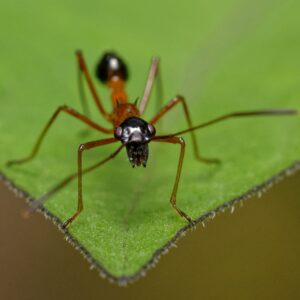
- Ant-mimicking spiders evolved to look like specific ant species and walk among them as undetected predators. The mimicry includes body shape, gait, and chemical signature.
Where to learn more
Most of these facts have substantial research behind them. If any caught your attention, the ant diversity guide covers the evolutionary context, the nine superpowers dives into the biology, and the species-specific guides (Cataglyphis, Harpegnathos, Dinomyrmex) get into the detail.
If a fact made you want to keep one of these species, we ship most of them. Browse live colonies or message us with the species name.
Did you like this article?
Thanks for your feedback!