




Why Are Ants So Interesting? Amazing Facts About Ant Colonies

Ants get described as “fascinating” in roughly every nature documentary, and the word does them no favours, it makes them sound generally interesting, which they are not. They are specifically interesting, in nine identifiable ways that would each be impressive on their own and which together explain why ants outweigh humans on Earth despite being millimetres long.
One superpower per section. No padding. Each one is what nature did to one particular problem, billions of years before we tried solving it ourselves.
1. They lift 10-50 times their own body weight
The neck joint of an ant is one of the strongest biological joints by relative load. Laboratory tests have measured workers carrying loads exceeding 50 times their body mass, and some species (Asian weaver ants) demonstrate sustained carrying of around 100 times their mass over short distances.
The mechanism: exoskeleton geometry and the cubic-square law. Small animals have lower body mass relative to muscle cross-section than larger animals. Scale a human down to ant size and they would lift comparable multiples. The “superpower” is partly physics, but the morphology of the ant exploits it more efficiently than almost any other invertebrate.
2. They navigate by polarised light
The desert ant Cataglyphis can leave its nest in a featureless sand basin, forage hundreds of metres in random directions, and return in a near-straight line to within centimetres of the entrance, without trails, without landmarks, without remembering the outbound path.
The compass is the sky. Polarisation patterns from atmospheric scattering form an invisible reference field that Cataglyphis photoreceptors read directly. Combined with step-count odometry, the ant maintains a continuous vector pointing back to the nest. We discuss the mechanism in the Cataglyphis species guide.
3. They farm fungus, and have done so for 50 million years
Leafcutter ants do not eat the leaves they cut. They take them underground, chew them into a paste, and use the paste to grow a specific fungus species (Leucoagaricus gongylophorus) that produces specialised nutritive structures the ants harvest. The relationship is so old and so co-evolved that the fungus exists only in association with these ant species.
The colony maintains its garden through pH control, antibiotic treatment (workers carry symbiotic bacteria producing antifungals against weed species), and active waste removal. It is industrial-scale agriculture, run by an insect, several tens of millions of years before humans figured out crops.
4. They coordinate raids of hundreds of thousands
Army ants conduct sustained foraging raids in which 200,000-500,000 workers move together through the forest, overwhelming any prey in their path. The raid front is a metre wide and advances at roughly 10-15 metres per hour, with side branches scouting independently. The chemical communication that coordinates this is sophisticated enough that researchers still publish papers about it.
Army ant species do not build permanent nests. The entire colony, queen, workers, brood, is mobile, bivouacking in a ball formed by interlocked worker bodies and moving every 1-3 days as the foraging area depletes.
5. They communicate with around 20 distinct chemical signals
Most ants speak a chemical language richer than human researchers have catalogued. Pheromones for alarm, recruitment, trail-marking, nest-mate recognition, queen-presence signalling, brood care signalling, and more. Some species use over a dozen distinct alarm pheromones, each communicating a different threat type, a different chemical for vertebrate predators, for other ants, for parasitoid wasps, for disturbed nests.
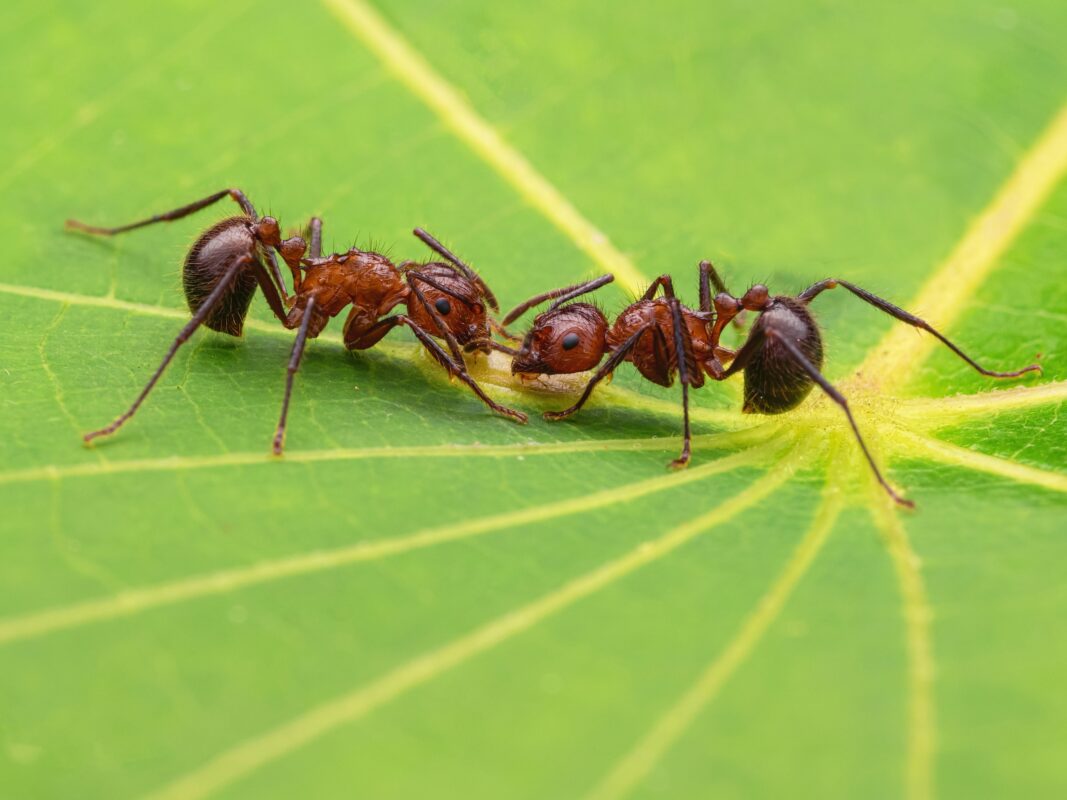
Worker ants spend much of their day reading these chemicals from antennal contact. The “tap-tap-tap” of antennae against another worker is a multi-sensory exchange that conveys colony identity, age, recent food intake, current task, and probably more we have not decoded.
6. They allocate jobs by age, and adjust dynamically
Newly emerged workers care for brood inside the nest. Middle-aged workers handle nest construction and food storage. Old workers, close to the end of their lifespan, leave the nest to forage. The dangerous job goes to the most expendable members.
The allocation is not fixed. If the colony loses workers at one age band (predator attack on foragers, disease on brood-carers), workers in adjacent age bands shift roles within days. Younger workers can be “promoted” to foraging duties; older workers can revert to brood care if the colony needs it. The mechanism is partly hormonal, partly behavioural feedback.
7. They build climate-controlled architecture
Termite mounds get more popular attention, but ant nests in temperate zones use sophisticated geometry to regulate humidity, temperature, and gas exchange. Multi-level nests built into soil maintain stable internal temperatures within ±2°C of optimal even as outside conditions swing 20°C between day and night.
The cooling mechanism is passive: vertical air shafts, chambers at different depths, soil moisture acting as a thermal buffer. Some species evaporate water from internal reservoirs to cool during heat waves. The architecture predates human passive cooling design by hundreds of millions of years.
8. They enslave other ant species
Slave-maker ants (Polyergus and several others) cannot perform basic colony tasks, they cannot feed themselves, raise their own brood, or maintain a nest. Their entire survival depends on raiding other ant colonies, stealing pupae, and raising those pupae as enslaved workers who maintain the slave-makers’ colony.
The behavioural complexity required to execute these raids, selecting targets, coordinating attacks, capturing brood without killing it, transporting it home, places Polyergus among the most behaviourally specialised animals known. It is unsettling to watch.
9. They are functionally immortal at the colony level
An individual ant lives weeks to a few years. A colony with a healthy queen can live decades. Some species replace the queen when she dies (Harpegnathos gamergates, see the species guide), making the colony effectively immortal as long as conditions hold. Other species swap queens through “supersedure”, the colony quietly rearing a replacement before the old queen dies.
The longest documented ant colony in cultivation passed 30 years. Wild colonies have been continuous for longer. As biological organisms, “the colony” is the unit that lives, and individual ants are its cells.
Which superpower draws you in?
If number 2 (navigation) caught you, Cataglyphis is the species to watch. If number 5 (communication) intrigues you, Pheidole has the most visually obvious division of labour. If number 9 (immortality) is the hook, Harpegnathos is the one you keep.
For a longer dive into ant evolutionary history and just how many different ways nature has solved problems with ants, the diversity of ants covers the 140-million-year story.
Did you like this article?
Thanks for your feedback!