




Best Ant Species for Ant Farms – Complete Beginner Guide

If you want a single decision-support table for picking an ant species, beginner or beyond, this is it. Ten species across difficulty levels, with the metrics that actually affect daily keeping rather than the ones marketing pages emphasise.
Use the table below to filter. The notes that follow explain what is not obvious from the columns.
The comparison
| Species | Difficulty | Adult size | Temperature | Humidity (nest) | Hibernation | Growth speed | Activity peak | Aggression | First-year cost (EU) |
|---|---|---|---|---|---|---|---|---|---|
| Messor structor | Beginner | 4-7 mm + majors 7 mm | 18-28°C | 50-65% | Light (optional) | Moderate | Day | Low | €35-60 |
| Messor barbarus | Beginner | 5-9 mm + majors 12 mm | 22-28°C | 50-65% | None / optional | Fast | Day | Low | €45-80 |
| Lasius niger | Beginner | 3-5 mm | 16-26°C | 60-75% | Required (5-12°C, 3-4 mo) | Slow year 1, fast year 2+ | Day | Low | €15-30 |
| Camponotus nicobarensis | Beginner+ | 5-12 mm | 22-28°C | 65-75% | None | Moderate | Mixed | Low | €55-90 |
| Crematogaster scutellaris | Beginner+ | 3-5 mm | 20-28°C | 60-75% | Light | Moderate | Day | Medium | €35-60 |
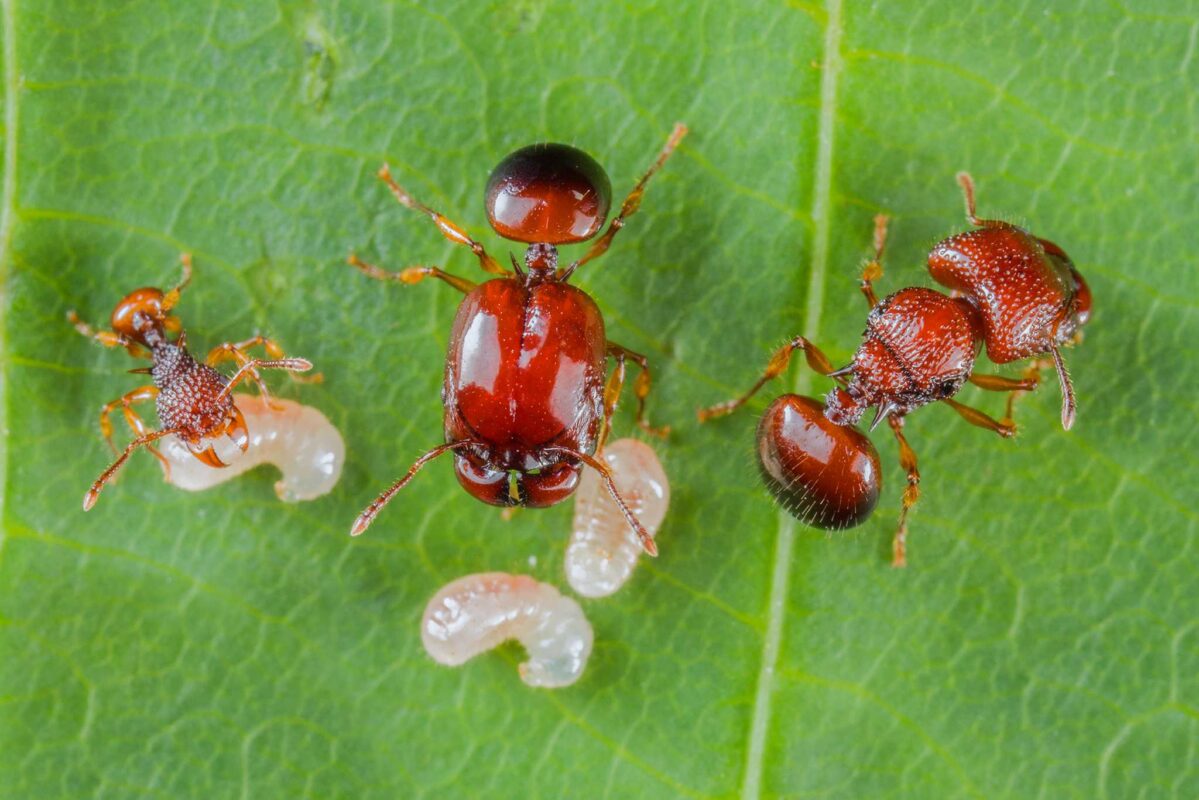
| Pheidole pallidula | Intermediate | 2-4 mm + majors 5-7 mm | 22-28°C | 65-80% | None | Very fast | Day | Medium | €30-55 |
| Formica fusca | Intermediate | 5-7 mm | 16-26°C | 55-70% | Required (5-10°C, 3-4 mo) | Fast | Day | Low | €20-45 |
| Polyrhachis dives | Intermediate | 7-9 mm | 23-28°C | 75-90% | None | Slow | Day | Low | €50-90 |
| Gigantiops destructor | Intermediate-advanced | 10-13 mm | 24-28°C | 80-90% | None | Moderate | Day | Medium | €80-150 |
| Harpegnathos venator | Advanced | 13-16 mm | 24-28°C | 75-85% | None | Slow | Day | High (sting) | €120-250 |
What the table doesn’t tell you
“Activity peak” is more important than it looks. A nocturnal species looks dead during the hours you actually want to watch them. Most beginners default to day-active species for this reason, even though some nocturnal genera (Dinomyrmex, certain Camponotus) are stunning under red light.
“Growth speed” is relative to your patience. “Slow” means 50 workers by year 1. “Very fast” means 800+. If you cannot wait to see results, fast-growth species are worth the higher feeding effort. If you want a slow, contemplative observation experience, slow-growth species like Polyrhachis reward attentiveness.
“Aggression” is about what they do to you, not what they do to each other. Most species are perfectly cooperative internally. The aggression column tracks whether the species bites/stings when disturbed during cleaning and feeding. Low-aggression species are forgiving of sloppy handling. High-aggression species are not.
“Hibernation required” means the colony degrades without it. European species that do not get 3-4 months of cold dormancy lose their queen within 2-3 years. If your apartment cannot deliver 5-12°C anywhere for the winter, those species are not realistic choices.
Quick filters
“I want the easiest possible start” → Messor structor or Lasius niger. Both are forgiving, both grow predictably, both teach the fundamentals of ant keeping.
“I want fast growth, lots of visible activity” → Pheidole pallidula or Messor barbarus. Both move the colony to “interesting to watch” within 3-4 months.
“I have a warm apartment, no cool space for winter” → Anything tropical: Camponotus nicobarensis, Pheidole, Polyrhachis, Gigantiops. Avoid Lasius and Formica.
“I want visual drama” → Pheidole (major/minor contrast), Polyrhachis dives (silver-spinous body), Gigantiops (eyes). For the maximum spectacle, see the Dinomyrmex gigas guide, not in this table because it is a different category of species, but worth a look.
“I’ve kept ants for a year and want a challenge” → Harpegnathos venator, Gigantiops destructor, or any of the truly advanced genera. Read the Harpegnathos guide before deciding.
If you are still stuck
Most beginners do well starting with Messor barbarus if they have a warm room, or Messor structor if they have a cooler one. Year two is the time to add a contrasting species, tropical if your first was temperate, social hunter if your first was a granivore.
Browse current stock: beginner-friendly, exotic, tropical, hibernating. If you can describe your room (winter temperature, summer temperature, available space), we will pick the right species for you in a reply.
Did you like this article?
Thanks for your feedback!