




How to Choose a Formicarium – Complete Beginner Guide

The formicarium is the biggest single decision in your first year of ant keeping. It determines what you can observe, how much your colony stresses, how often you need to clean, and, long term, whether you will be moving the colony in 12 months because you bought the wrong one.
This guide walks through the five material types, with honest pros and cons, then maps colony size to formicarium size. By the end you should know exactly what to order.
The five material types, at a glance
| Material | Visibility | Humidity control | Cleaning | Durability | Price (small) | Best for |
|---|---|---|---|---|---|---|
| Acrylic | Excellent | Manual (water tank) | Easy | 10+ years | €25-60 | Visual observation |
| Gypsum | Front-only | Self-regulating | Hard | 5-15 years | €20-50 | Stable humidity |
| 3D-printed | Varies | Depends on design | Easy | 3-10 years | €15-40 | Custom shapes, budget |
| Wood + glass | Front-only | Self-regulating | Medium | 5-10 years | €30-80 | Naturalistic look |
| Modular (acrylic) | Excellent | Manual | Easy | 10+ years | €40-100+ | Long-term colonies |
1. Acrylic, what most people get first
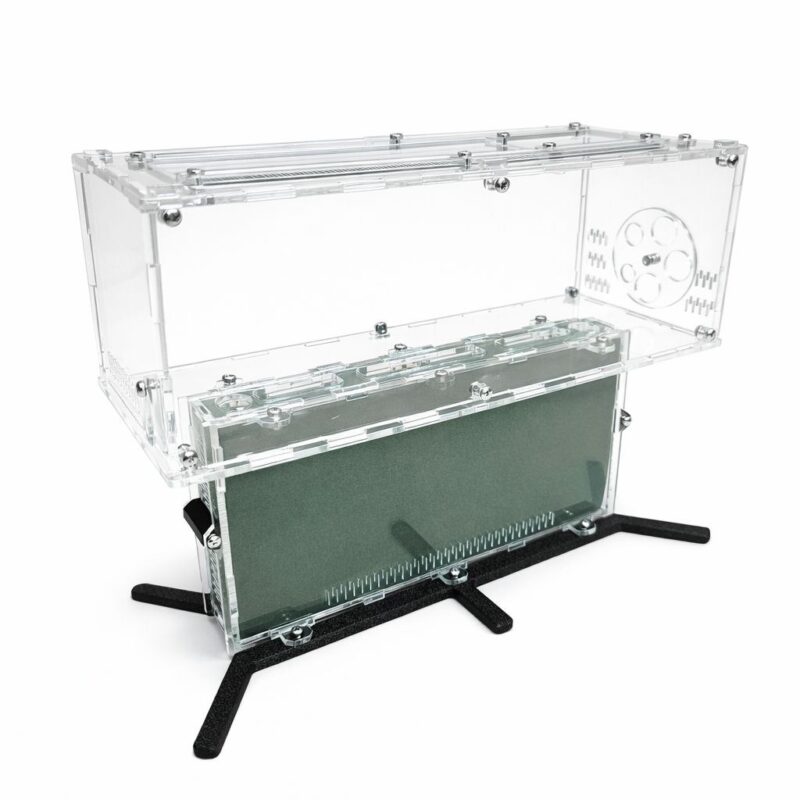
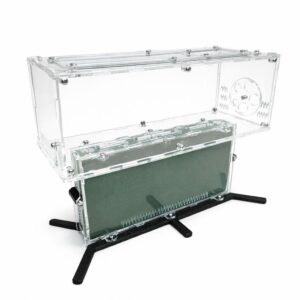
Acrylic formicaria are clear plastic blocks with chambers carved out, sealed with a flat acrylic cover. Visibility is excellent, you see every chamber from the front and often the sides. Humidity is controlled by adding water to a built-in reservoir, which slowly releases moisture into the chambers.
Pros: best observation in the hobby. Durable. Easy to clean. Wide range of designs. Easy to connect to outworlds.
Cons: humidity is your job, not the formicarium’s. If you forget to refill the reservoir, the nest dries out. Manufacturer quality varies, cheap acrylic may scratch or have rough edges where workers get stuck.
This is the default recommendation for most beginners. Browse acrylic formicaria.
2. Gypsum, the humidity-self-regulator
Gypsum (plaster) formicaria use a porous material that absorbs and slowly releases water. The chambers are typically carved into a gypsum block, with a glass or acrylic front for observation.
Pros: humidity is self-regulating. Add water to the back once a week and the chambers stay humid for days. Ideal for species that need stable high humidity (rainforest tropical: Polyrhachis, Gigantiops, Harpegnathos).
Cons: cleaning is harder. Gypsum stains and absorbs anything spilled in the chambers. Long-term, the material can develop mineral deposits that affect humidity. Visibility is front-only, you cannot see chambers from the side.
Choose gypsum if you keep tropical species and prefer set-and-forget humidity. Browse gypsum formicaria.
3. 3D-printed, the customisable option
3D-printed formicaria are made from PLA, PETG, or resin, with chambers cut into the body. Most have a clear cover for observation.
Pros: flexibility of design, custom shapes, integrated outworlds, themed builds. Lower cost than premium acrylic in many cases.
Cons: material quality varies hugely. Some prints have rough surfaces where ants get caught or where mould grows in pores. Long-term durability depends entirely on the filament used. Not all prints handle humidity well.
For experienced keepers willing to research the specific brand, 3D-printed can be excellent. For beginners, the variability is risky.
4. Wood + glass, the natural look
Traditional formicaria use a wooden frame with glass or acrylic on one side, often with a soil or sand substrate inside. The look is naturalistic and many keepers prefer the aesthetic.
Pros: humid microclimate without complex reservoirs (wood absorbs and releases moisture similar to gypsum). Visually appealing on a shelf. Substrate inside lets ants dig.
Cons: harder to clean. Mould risk if humidity is wrong. Visibility limited to the glass side. The substrate makes it hard to track exactly what is happening in the colony.
Good for keepers prioritising aesthetics over observability.
5. Modular acrylic, for colonies that will grow
Modular systems are acrylic formicaria with the option to add more chambers, more arenas, or connect multiple modules together. Designed for colonies that will expand over years.
Pros: expand without moving the colony. Add a new module, the colony explores and uses it. No high-stress migrations.
Cons: significantly more expensive. Initial setup is more complex. Some designs require specific brand-matched modules.
If you are confident your first colony is the long-term one, modular makes sense from day one. Browse modular ant nests.
Sizing, match the formicarium to the colony, not the future
This is where most beginners get it wrong. They buy a beautiful large formicarium for their founding queen, and the colony struggles for months in the empty space because humidity and temperature cannot stabilise in chambers many times too large for the workforce.
The rule: buy small first, plan to expand, or buy modular and start with just one small module.
| Colony stage | Worker count | Recommended nest size |
|---|---|---|
| Founding (months 1-3) | 1-20 | Test tube only, or 3 × 4 cm formicarium |
| Early growth (months 3-9) | 20-100 | 4 × 6 cm formicarium |
| Established (months 9-18) | 100-300 | 6 × 10 cm formicarium |
| Mature (year 2+) | 300-1000+ | 10 × 15 cm or modular setup |
Species adjustments: large species (Camponotus, Dinomyrmex) need taller chambers. Small species (Pheidole, Tetramorium) can use shorter chambers but need more total floor area.
The arena, separate from the nest
Some formicaria come with built-in arenas; others connect to a separate “outworld” where the ants forage. Arena size matters more than people expect.
For most beginner species, an arena of 20 × 15 cm is enough for the first year. For active foragers (Cataglyphis, Pheidole, large tropical species), 30 × 20 cm or larger is appropriate.
The arena needs: smooth vertical walls (escape-proof), a tight-fitting lid, a thin substrate layer, room for a feeding dish and decorations.
Brand notes
The market has dozens of small makers and a handful of larger brands. Some categories on this site:
- DigFix formicaria, premium 3D-printed with integrated chambers
- Acrylic options, our largest category
- Gypsum/plaster, for humid-loving species
- Modular systems, for long-term planning
- Starter kits, formicarium + arena + accessories in one box
Common mistakes
- Buying too big. A founding colony in a 10 × 15 cm formicarium cannot maintain humidity. Brood dies, workers exhaust themselves.
- Buying multiple formicaria “to compare”. The colony moves to whichever has best conditions and you waste money on the others.
- Choosing by looks first. The colony does not see the aesthetic. You will, but choose function first.
- Forgetting the outworld. A beautiful nest with a tiny arena defeats observation.
- Ignoring brand reviews. Cheap unbranded formicaria sometimes have basic flaws (rough edges, leaking reservoirs) that no amount of preparation fixes.
If you have read this far and still cannot decide, our default recommendation is: an acrylic formicarium sized to your founding colony, a 20 × 15 cm arena, both from the same maker so connections fit. Total cost €40-70. Upgrade in year 2 if the colony thrives.
Browse the full range or write to us with your species and we will pick a setup for you.
Did you like this article?
Thanks for your feedback!